

While doing some research for Defining the 12 Fatal Issues for Small Business (which eventually would evolve into The Trapped Operator), I stumbled across a 2021 study published in the Journal of Business Venturing Insights. The basis of the research was that crisis events, such as COVID-19, affect more than the finances of a small business. They also affect the owner’s emotional and psychological well-being. In the article, the researchers-Stephens, McLaughlin, and McLaughlin—applied the Kübler-Ross model to small business owners during COVID-19, illustrating how closures triggered grief in five stages: denial, anger, bargaining, depression, and acceptance.
While you likely haven’t heard of the Kübler-Ross model (or at least I hadn’t), there’s a high probability that you’ve heard of the five stages of grief, which are widely used in personal grief studies. The researchers took the unique view of applying this framework to business grief. Like personal grief, the stages of small business grief aren’t linear.
Their study utilized structured interviews with 40 Irish small business owners who were forced to close their businesses due to COVID-19. The interviews occurred over a six-month period during the pandemic. Five interviews were conducted with each participant, focusing on emotional progression and personal adaptation in addition to the business outcomes.
Identity Loss and Irrelevance
It should come as no surprise that the researchers found owning a business isn’t just professional. For many owners, their business is an extension of themselves, closely tied to purpose, family legacy, self-worth, and future.
These identities run deep. Long after the founder steps away, the company and their name often remain intertwined. Mention Steve Jobs and Apple comes to mind. Microsoft brings Bill Gates. Elon is Tesla and Tesla is Elon. The owner isn’t just a creator. They become the entity. And the entity becomes them.
The loss of a business, then, is a uniquely personal and messy experience. The researchers found that five stages of grief didn’t follow a clean or predictable path. In the interviews, owners moved back and forth through stages. Some skipped entirely, only to revisit them months later. But over time, one theme kept surfacing: owners didn’t fear financial collapse as much as they feared irrelevance. Because once their names are off the sign, who are they now?
Many owners in the study, for the first time in years, were forced to be still. That pause gave them space to step back and reflect on what really mattered. Some questioned whether the grind of ownership was still worth it, or even sustainable. By the end, many had developed new operating models to create better balance. Others made long-delayed life choices, choosing to prioritize family, scale back operations, or exit the business entirely.
Like all loss, over time, there comes recalibration.
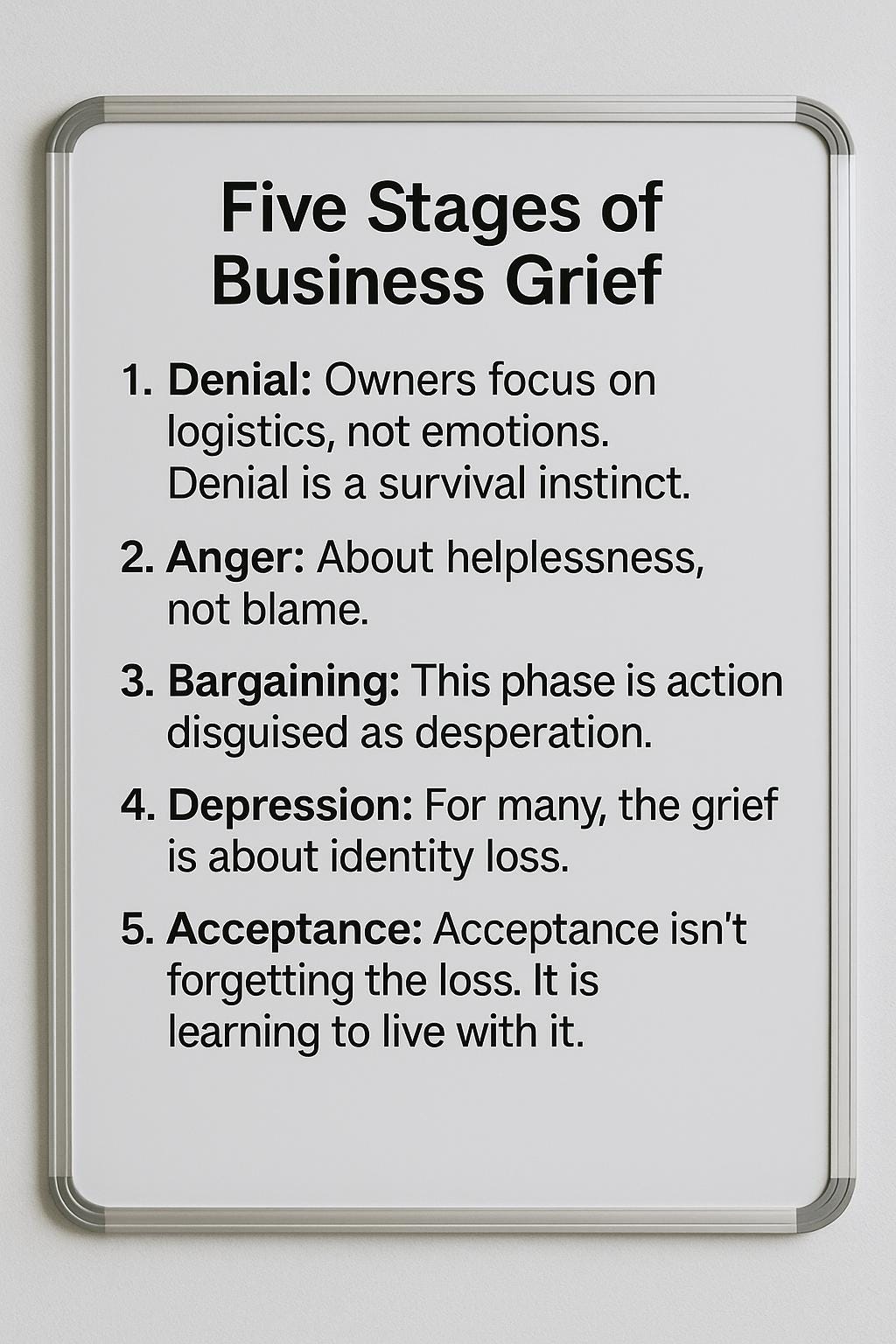
What the Grief Stages Look Like in Business
Denial: Owners focus on logistics, not emotions. Denial is a survival instinct.
Owners rushed to solve problems, telling themselves “It’ll pass,” or “This is just temporary,” even when the cracks were widening.
Anger: About helplessness, not blame.
The anger wasn’t irrational. It was grief masked as indignation.
Bargaining: This phase is action disguised as desperation.
Bargaining gave owners a sense of motion. Some negotiated with staff, banks, or even themselves. It was an emotional lifeline
Depression: For many, the grief is about identity loss.
The study found that regression was possible, especially if new shocks emerged. But acceptance often marked the beginning of reinvention.
Acceptance: Acceptance isn’t forgetting the loss. It is learning to live with it.
The study found that regression was possible, especially if new shocks emerged. But acceptance often marked the beginning of reinvention.
My Family’s Story Begins
Until I stumbled upon this article, I hadn’t ever thought about the stages of grief from the standpoint of business grief, or at least I had never articulated it that way. I’ve walked through the stages. Even now and again, I might still jump to anger or depression when I think back to having to close my dad’s business, less than a year after losing him. Without realizing it, I was back in the middle of the same grieving process of losing my dad all over again.
I had been working with him for nearly 18 years at that point and still remember him launching the company when I was four years old.
I remember my dad having the machinery in our basement when he first launched. The business and I grew up together and competed for resources, as is the way with all small family businesses.
The decisions made for a small business directly impacts the life of every family member, not just the owner. The moments of the business get seared in your mind like any of your own life events.
I remember the first space he leased, where I learned to match packing slips to incoming items when I was six. I remember him building the first building, tired of paying for someone else’s real estate investment when I was in third grade, and I worked alongside him as the business, now age 31, outgrew that space and built a bigger location when I was 35.
My family lost my dad in May 2019. I remember the phone call, I remember driving to my parents’ house, and then it goes a bit fuzzy for several months. Yes, I was there, but I wasn’t mentally present. I was going through the motions, doing what I was supposed to do, or at least trying to as the day after my dad passed, I was at work, as I needed to let everyone know had happened.
Denial wasn’t an option. It went straight to anger and depression. Somewhere along the way, I fooled myself into thinking I had reached acceptance. But I know I never truly accepted my dad’s passing. Less than a year later, on January 13, 2020, I was standing in front of the whole company again. This time, I was letting them know it was the business that had just died.
The Decision to Sell
I need to provide some context here. We made the decision to sell during the second half of 2018, as we recognized the company was built around my dad’s expertise. Our product line evolved into a sophisticated engineering offerings that required high-level software support, which functioned under the vision and direction of my dad.
My talents are far from mechanical, so my dad’s exit would require additional staffing, eliminating the profit stream expected to serve as his retirement annuity. We never planned a formal exit, which is one of the few contingencies that we never put into place. When he passed, the identified knowledge gaps unfolded real-time.
Many facets of our company’s success hinged so closely on my dad’s direction that we were stuck. It wasn’t about not knowing what to do. I knew the steps. I just didn’t have the mental capacity to take them. I was operating from a place of anger and depression, overwhelmed by a grief I couldn’t yet name.
In less than nine months, I had lost my dad and my only sibling. To the outside world, that second loss was just a business that closed, to me it was so much more.
Another Fight to Keep the Business Afloat
After closing the business, I stepped out of the noise. I knew deep down I was never going to be able to fix it. The truth was simple. My skillset didn’t match what the business had become. So, I swallowed my pride and sent off an email to a competitor I knew had been sniffing around.
It was short. If they wanted the product line, now was the time to contact the broker handling our sale. That became my new challenge for the next two and a half months. Grieve the loss of my dad. Shut down his legacy. And find a way to liquidate a product line that no longer had the mind that built it.
COVID Hits…and So Does the Clock
Those two and a half months were hell. I wouldn’t wish them on anyone. Within weeks, we had a handshake deal, but it hinged on transferring an IP license from a different competitor. That part of the story is complicated. The original license was contentious. We had parted ways with no expectation of needing to talk again. But I knew the transfer was unavoidable, so off to Dallas I went.
March 11, 2020. Sitting in the airport waiting to fly back to New Hampshire, I saw the news break on the overhead TVs. The NBA was suspending its season. Rudy Gobert had tested positive for COVID. Within days, the entire world began shutting down.
The sharks were circling. We needed that deal to close to pay the bank and the vendors, many of whom hadn’t seen a payment since late 2019. The buyer had taken a risk by funding a lease-employee arrangement to keep us afloat during the transition. But everything was fragile. The deal was set to close at the end of March, and suddenly every force outside our walls was working against us.
Scrambling to Close
Then one break fell our way. We were deemed essential. That gave us room to keep operating. And yes, I took some liberty with that definition, but we made testing equipment for diesel and automotive repair shops. A few customers were in those categories, so it held.
On Thursday afternoon, March 26, I got a flood of last-minute due diligence requests with a note.
"All of this must be completed by Monday morning for a March 31 closing. Given the depth, we recommend rescheduling to April 30."
I replied instantly. Everything would be ready by Monday. I had no idea how, but there was no option.
That weekend, I got lucky. Our attorney locked in with me. For me, the deal needed to close because I needed a finish line. For him, it became a challenge to see if we could actually pull it off. We worked nonstop all weekend.
Monday morning, the buyer called: “My attorneys said they’ve never seen anyone pull together documents like that.”
When you are staring down the barrel of a loaded gun, you move faster. You don’t have time to think about the pressure. You have to just keep moving.
We closed remotely on March 31. A week and a half later, we closed on the sale of the building and secured a leaseback to give the new owner a year to move out. I stayed on for a while, but I wasn’t happy. Every day I was there felt like being haunted. It was a constant reminder of what had been lost.
The Aftermath and the Void
I’m not sure I’ve reached acceptance. I really don’t believe I ever will, I think it just becomes learning how to live with the void. Six years later, I’m still searching for answers. The failure led me to pursuing my DBA, which aligns with the researchers’ statement that acceptance is marked by reinvention, so in that way, I guess I can SAY I’ve reached acceptance.
My studies have shown me that 60% of family businesses that try to execute a generational transfer fail, a statistic that has remained unchanged since first being presented in 1986. This would make it seem as though the idea to sell was the logical move. But here’s another little-known fact, roughly 30% of small businesses listed for sale successfully sell, leaving 70% without a buyer or succession plan (Teamshares, 2025).
The reality is, without a change of course, 70% of all small business owners are heading towards theses five stage of business grief.
Wrestling Against Time
My reinvention led me to founding Wrestling Against Time. Having lived through these experiences and reflected on the missteps along the way, I wanted to build something that helps others avoid the same fate.
Wrestling Against Time is focused on helping small business owners navigate the twelve fatal issues that quietly destroy businesses from within. Some of these issues helped weaken our organization. Others we managed to hold off, even if we didn’t always know it at the time. What I’ve come to believe is that by confronting these issues directly, owners give themselves the best chance to scale the business the right way and eventually step away without losing everything they’ve built.
It is not just about succession. It is about strengthening the business in the years leading up to it. It is about building something designed to last beyond the founder, without financially crippling whoever comes next.
A Final Thought for Now
Grief does not follow a timeline. Neither does reinvention.
What I’ve learned through research, reflection, and the long road back is this. The end of a business doesn’t have to mean the end of an identity. It simply means that identity needs to evolve.
Wrestling Against Time was born from that evolution. It is built on the belief that the grief of succession, closure, and reinvention can be understood, prepared for, and ultimately transformed. It does not erase the past. It honors it by building something meant to endure.
This journey has led me to reframe how we look at business succession. Not as an ending, but as a realignment. One that connects the entrepreneurial vision to the strengths of the next generation.
One that lets founders step aside with pride.
One that replaces grief with legacy.
Have you faced a business loss? Which stage of grief hit you hardest?
References
Stephens, S., McLaughlin, C., & McLaughlin, K. (2021). Small business in a time of crisis: A five stage model of business grief. Journal of Business Venturing Insights, 16, e00282. https://doi.org/10.1016/j.jbvi.2021.e00282
Teamshares. (2025, June 5). Selling with purpose: Why retiring small business owners should consider the Teamshares model. Teamshares. https://www.teamshares.com/resources/selling-with-purpose/


Very well written. I've restacked this with my comments. Thanks for posting such a sensitive narrative.