

Plans were drawn and concrete poured
Nail by nail and board by board
Daddy gave life to Momma's dream
— Miranda Lambert, “The House That Built Me”
The faint groan of the upstairs toilet flush cut through the quiet house.
Sounds like Sleeping Beauty’s finally up, Sara thought, her lips twitching with a wry smile that didn’t reach her eyes. Jordan could sleep through a hurricane, his snores a steady rhythm against the chaos of their crumbling business.
Sara wasn’t wired that way. One stray worry—a late invoice, a bounced check, Niko’s college fund—and her mind was a hamster wheel, spinning until dawn.
Last night had been no exception. After Jordan retreated to bed, Sara stayed at the kitchen table, the red notebook open under the dim glow of a single bulb. Its pages, scrawled with Mikey Beaudet’s jagged truths, had ignited hope in Jordan—a spark of possibility.
For her, they lit a different fire: panic.
Not because Mikey was wrong, but because he was too right.
Every line about cash flow, margins, and control held up a mirror to their mistakes—mistakes she’d seen coming but couldn’t stop.

Her fingers traced the notebook’s worn edges, the same way she used to trace the grain of oak crates on her family’s factory floor in Manchester, New Hampshire. Back then, the world made sense: invoices matched, inventory tallied, systems hummed.
Jordan’s dream? It was a startup with no blueprint, a house built on sand.
Her childhood summers weren’t sleepaway camps or beach trips. They were spent in the hum of her family’s furniture factory, learning to match invoices at twelve, counting crates of hinges and screws with her dad, watching her grandfather sketch Murphy bed kits on diner napkins over late-night coffee.
That business was a legacy, battle-tested by generations, grounded in systems and certainty. Jordan’s business, though, was a rocket with no guidance system, and she was tired of watching it veer off course.
The creak of floorboards snapped her back.
Jordan shuffled into the kitchen, his broad frame filling the doorway, eyes bleary but locked on the coffee pot like a lifeline.
“Good morning, hot stuff,” he said, his voice gravelly. “Did you sleep at all? I got up at 3 to pee, saw you weren’t in bed.”
“Maybe an hour,” Sara admitted, rubbing her temples. “My brain wouldn’t quit. That capital calculator Mikey talks about? It’s a bomb. Cash flow, pricing, reserves—it’s all connected. Get one wrong, the whole thing collapses. It’s fucking overwhelming, Jordan. How is something this much smaller than my family’s company so damn hard to control?”
Jordan winced, catching the spiral in her eyes—that sharp edge she got when the unknown loomed too large. Sara thrived on anchors, plans, certainty. Drifting scared her more than hard work.
He poured coffee into his 32oz Yeti, draining the pot. Her glare reminded him to start another. He did, the machine gurgling as he slid into the chair across from her.
“Okay,” he said, grabbing the red notebook and flipping it open. “You and I are reading this thing very differently.”
“Correct.” Sara’s voice was clipped, arms folding. “I’m reading it like a business owner. You’re reading it like a dreamer.”
Shit, Jordan thought, his stomach sinking. Not where I wanted this to go.
He’d spent years chasing jobs, dodging creditors, telling himself he could outrun the math. The notebook had shaken him awake, but Sara’s words stung because they were true. He was still half in dreamland.
“That’s not fair,” he said, softer than he meant. “I didn’t sleep much either, Sara. But this time, I’m trying to be realistic.” He tapped a page, Mikey’s blocky handwriting staring back.
“Management Incompetence—If you’re controlling everything, you’re growing nothing.’”
That’s not just about leadership. It’s a mirror. It’s me.”
Sara’s eyes flicked from him to the page, torn between fight mode and curiosity. She leaned forward, just an inch.
“So… what are you saying?”
“I’m saying we do the audit. Right here. Right now.”
She didn’t speak. Just stood, her chair scraping the linoleum, and disappeared into the hall.
A moment later, she returned with a worn file box—cardboard edges frayed, marked with coffee rings and faded Sharpie labels. She dropped it onto the table with a thud that rattled the saltshaker.
“Let’s see how honest we’re ready to be.”
The kitchen became a war room.
Invoices spilled from folders, their edges curling like old love letters. Bank statements mingled with Jordan’s scribbled estimates, some on napkins echoing Sara’s family legacy.
She fired up QuickBooks on her laptop, the screen glowing with red numbers screaming past due.
Jordan grabbed a whiteboard from Niko’s craft bin, its edges smudged with glitter, and propped it against a chair.
First item: Pricing.
“This job,” Sara said, pulling a folder, “you quoted fourteen thousand. Materials and labor cost us nearly thirteen.”
Jordan rubbed his neck. “Client was hesitant. Didn’t want to scare him off.”
“You didn’t scare him off. You scared the profit off.” Her voice was steady, not cruel, but it cut deeper for it.
He grabbed a marker.
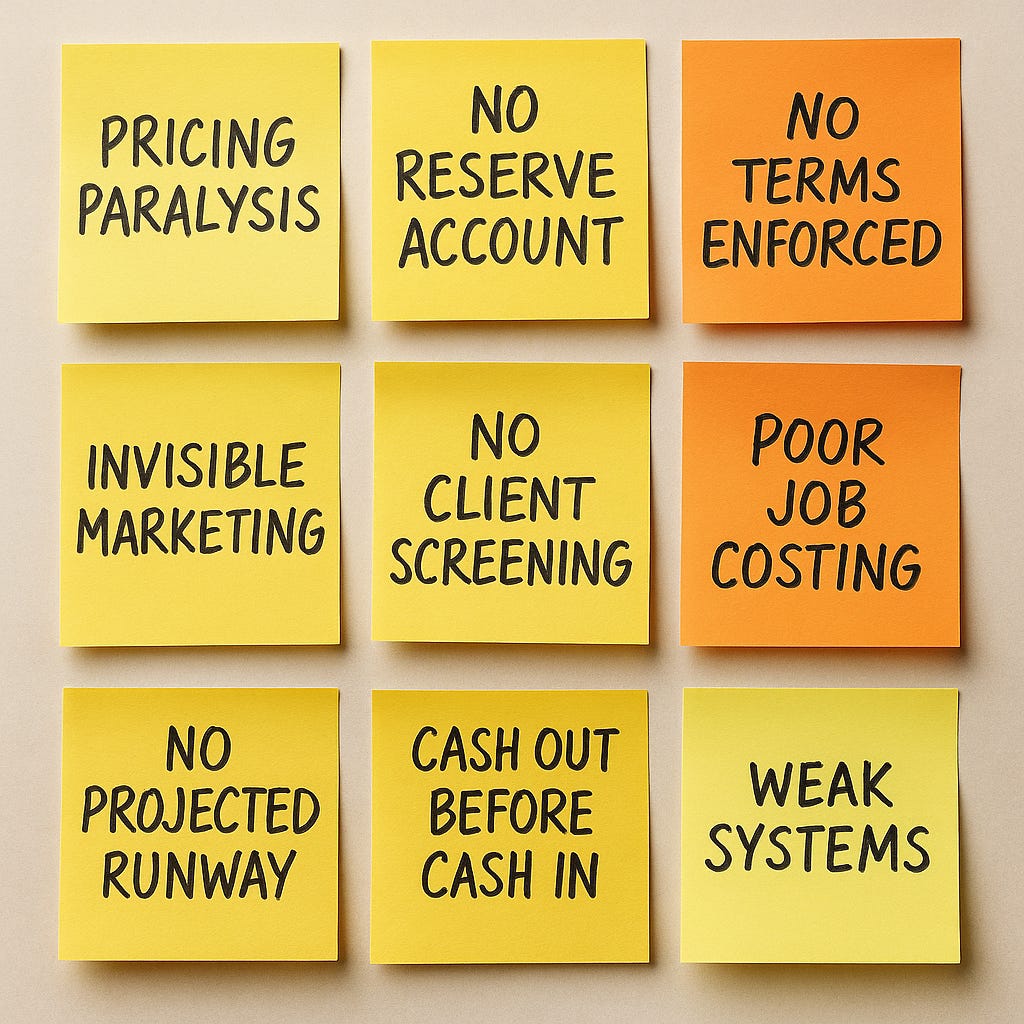
PRICING PARALYSIS
Second item: No Reserve.
“There’s three hundred bucks in the business account,” Sara said, clicking through QuickBooks. “You took a draw to pay the truck.”
“The note was due,” Jordan muttered, defensive.
“So now payroll depends on payments from customers that we don’t control?”
NO RESERVE ACCOUNT
Third: Terms.
“You fronted six grand in materials here,” Sara said, holding an invoice. “No deposit. No contract.”
“He’s a repeat client—”
“So was Steve. You remember how that turned out?”
Jordan sighed. No answer needed.
NO TERMS ENFORCED went up.
They kept going, the whiteboard filling with battle scars:
Invisible Marketing
No Client Screening
Poor Job Costing
No Projected Runway
Cash Out Before Cash In
Somewhere between the numbers and the notes, it stopped feeling like blame. It felt like grief—grieving the business they thought they had.
Sara didn’t gloat. She tallied, her glasses slipping down her nose, fingers steady.
“I wasn’t trying to hide,” Jordan said, voice low, eyes on the whiteboard. “I was just trying to outrun it all.”
Sara looked up, fingers pausing on the keyboard.
“I know. But trying to outrun reality just means it hits harder when it catches you… and it always catches you.”
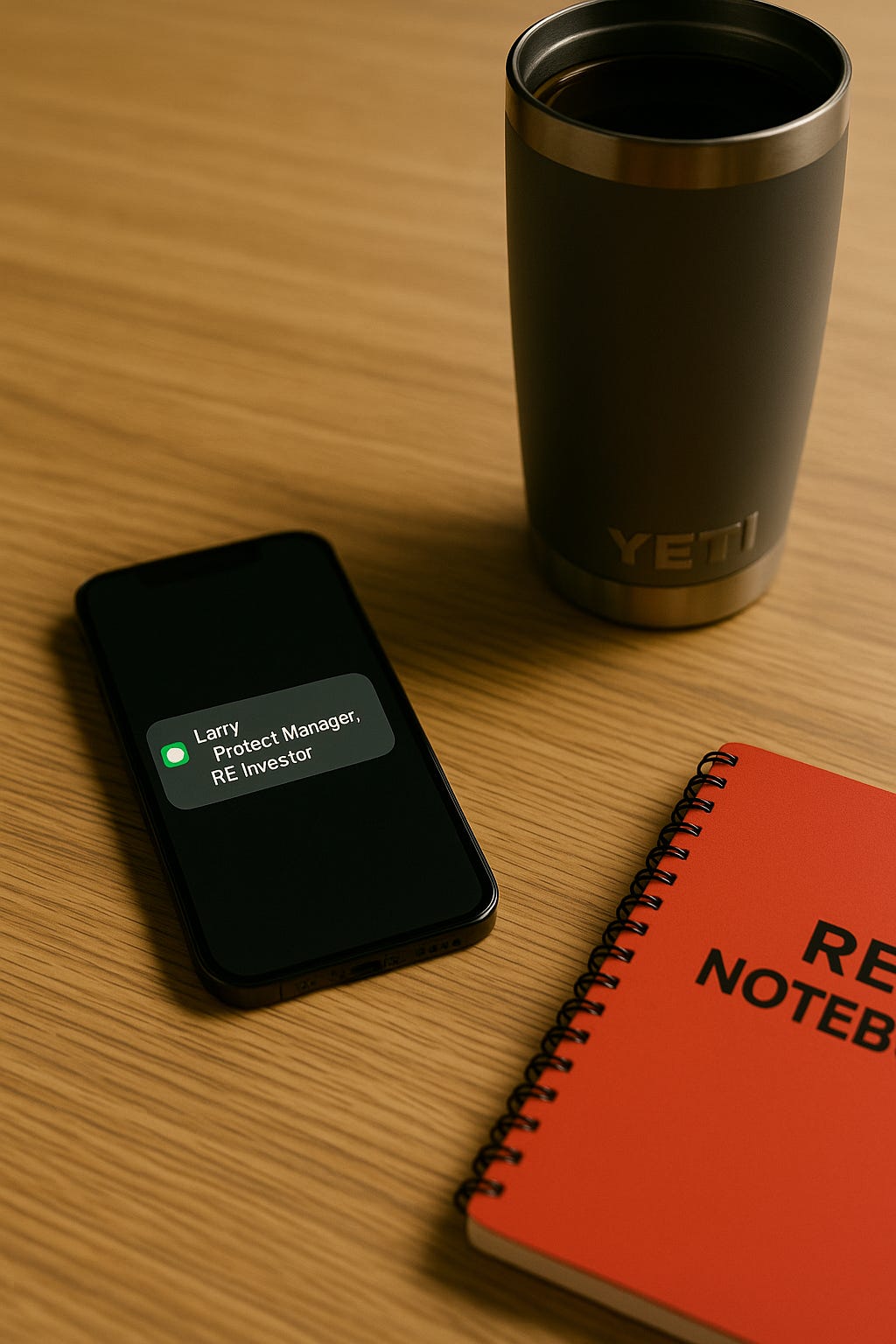
His phone buzzed.
A text from a developer client:
Hey bud, quick bid needed. Larger investor group looking at several lots. Bit of a contingency-based job. Quote by Friday. Sent you the packet.
Jordan stared at it.
A month ago, he’d have leapt at it—big potential, vague promises. The kind that bled them dry.
He saw himself last spring, begging a supplier for an extension, Sara’s spreadsheet glowing red in the background.
Sara caught his pause. “Anchor or lifeline?”
He typed:
Appreciate the ask, but we can’t start anything new without a signed agreement and deposit. Let me know if you can make that work.
Send.
The phone clattered onto the table, a small act of defiance against his old self.
“We’re not that business anymore,” he said, meeting her gaze.
Sara gave him a smile. Not soft. Not dramatic. Just real.
She peeled the sticky notes from the whiteboard and taped them to the fridge.
She flipped open the red notebook, her finger tracing a line:
Control what you can. Then double-check what you thought you controlled.
“This one’s mine,” she said, circling it in sharp, deliberate strokes.
Jordan thought of Mikey’s story—the pre-audit that saved his shop from a Labor Department fine.
You don’t wrestle alone, Mikey had written.
Jordan saw it now: Sara’s spreadsheets, her late nights, her quiet strength holding their life together while he chased jobs that didn’t pay.
Relief washed over him, warm and unfamiliar.
Sara opened her laptop, the screen casting a blue glow.
“We need a brand, Jordan. Not a hustle. A direction.”
She typed domain names: StrathamBuilds. AnchorHomes. SolidGroundConstruction. Then paused.
“Let’s not rush it. We want to get it right—because, you know, Sara... Everything Matters!”
Jordan couldn’t help himself. The line was cheesy, and the grin on his face made it worse.
Sara rolled her eyes, but the corner of her mouth gave her away.
“We’ll find it. Something that fits us,” she said, closing the laptop halfway.
The notebook rested on the table, its pages dog-eared but unbowed.
Jordan saw Niko’s future in it. He saw a blueprint—not just for a business, but for a legacy, like the one Sara’s great-grandparents had started.
Their rebuild was underway.
And for the first time in a long time, Jordan let himself believe—really believe—that maybe he wasn’t alone in the fight.
To be continued...

