

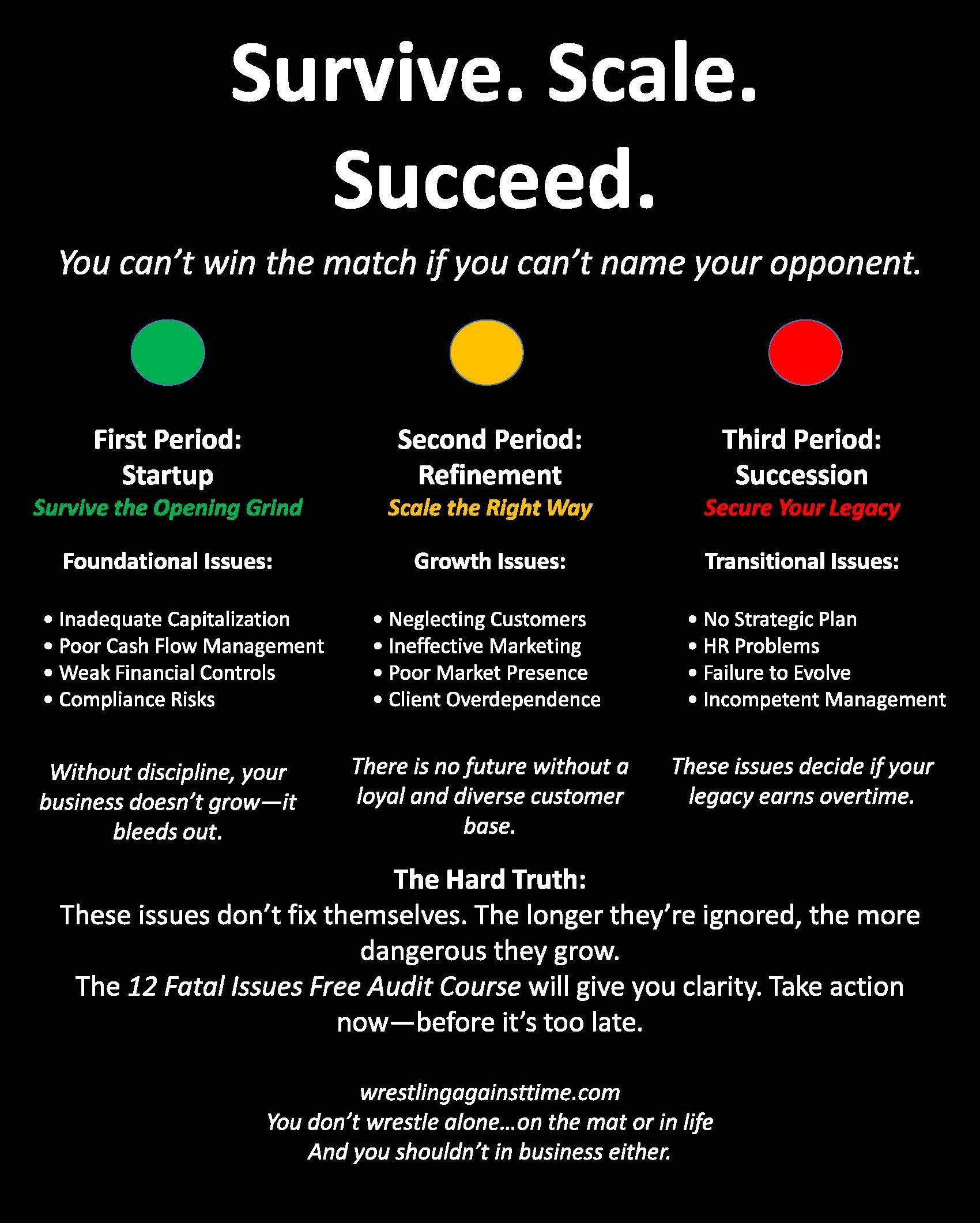
Poor pricing quietly erodes a business across multiple domains, which is why it’s one of the most important strategies for small business owners to master. But pricing mistakes are often symptoms of deeper structural issues that have already entered the business. In our framework, we call these the 12 Fatal Issues for Small Business, ever-present risks that show up in every stage of a business and compound when ignored.
Of the 12, pricing is directly tied to 7 of them. That’s why it gets so much attention. It’s a reflection of what’s already happening under the surface, and when it’s off, everything else gets harder.
If you lack accurate financial controls, you don’t know your true cost per hour on your primary production equipment, and the odds of setting the right price are slim to none.
If you can’t properly project production costs, your budgets are fiction. The revenue you bring in will never produce the profits you planned. Pricing built on bad assumptions leads to forecasts you can’t meet.
Before long, you’re explaining to the bank why you missed your debt coverage ratio on your line of credit and scrambling to prevent it from being pulled.
Your pricing strategy is shaped by the issues already inside your business. But it doesn’t stop there. It also sharpens those same issues and drives them deeper. The problems that push you toward poor pricing are often made worse by the pricing decisions you’ve already made.
That’s what makes it so dangerous. It cuts both ways.
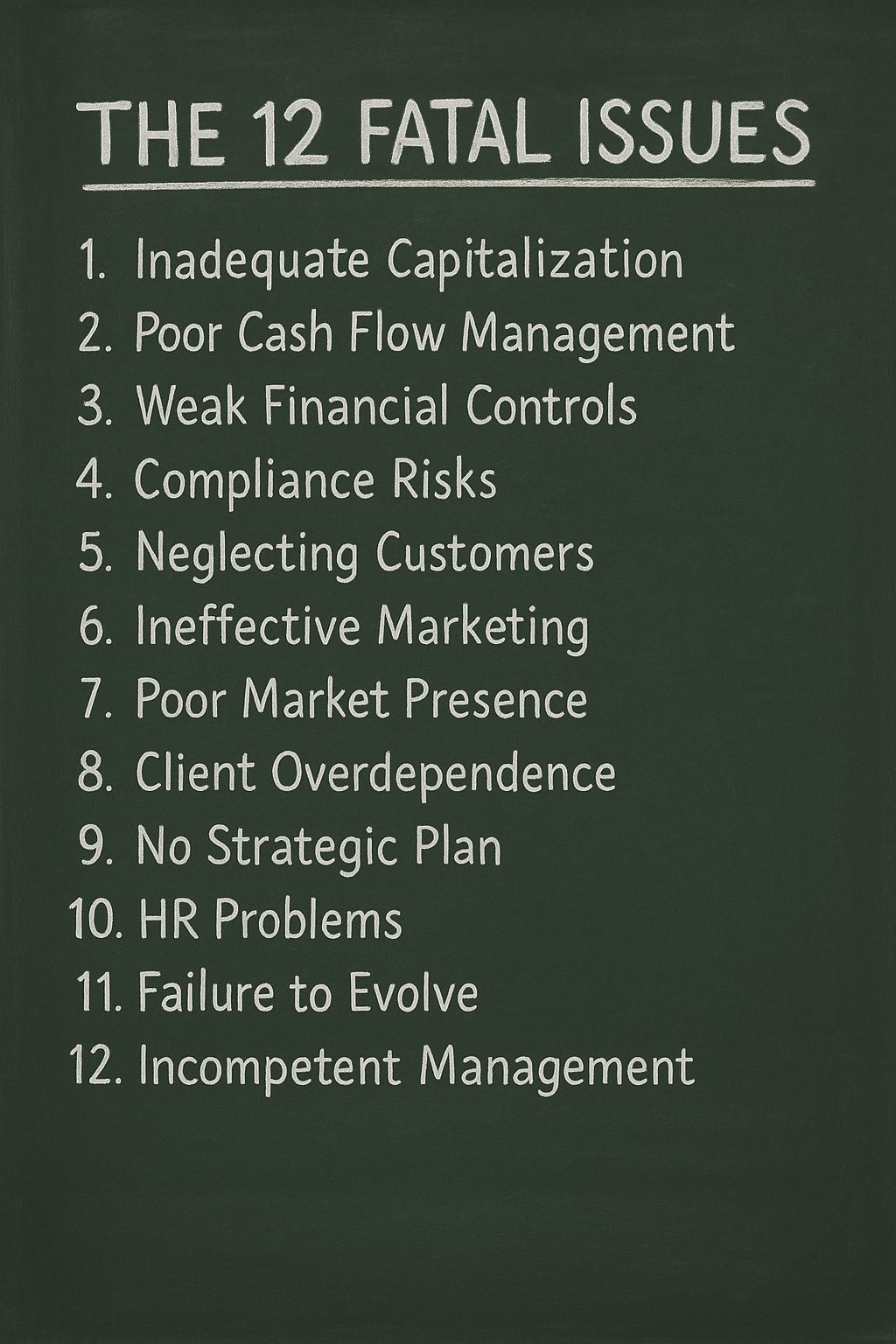

🚨 Fatal Issues Intertwined with Pricing
A poor pricing strategy is often the trigger or the result of deeper, structural weaknesses in the business. This adds to the difficulty of developing an effective pricing strategy. The impact flows both ways. Here are the 7 Fatal Issues that directly cause, contribute to, or are worsened by poor pricing strategy:
🔻 Inadequate Capitalization
Many small businesses launch with limited savings or borrowed money. To stay afloat, they take low-margin jobs just to get revenue flowing. But those early pricing decisions are difficult to reverse as the pricing mentality seeps deeper into the business. Over time, the business owner believes that fortunes can be reversed through volume rather than margin. This pricing trap prevents the business from generating the profits needed to fund growth, hire staff, or invest in systems.
🔻 Poor Cash Flow Management
An ineffective pricing strategy puts constant pressure on cash flow. When prices aren’t built from the true cost of delivery, including overhead, time, and support, cash tends to arrive late, fall short, or not show up at all. This leads to vendors waiting, bills getting juggled, and owners skipping their own paychecks just to keep operations running.
A 2024 PYMNTS report found that 45% of small business owners have done exactly that.
That pressure to cover the gap often leads to taking jobs below the company’s pricing standards just to bring in cash. And the cycle repeats itself.
🔻 Weak Financial Control
Accurately calculating what it costs to deliver a product or service is difficult. It takes time, discipline, and expertise, and most small business owners don’t have much to spare. So instead of running actual calculations, many default to pricing based on what feels fair or what competitors are charging, without knowing whether those numbers lead to profit.
Now try using that approach to price a new product line or service offering. And that’s before we even get into proper expense categorization or things like depreciation. The financial controls quickly become a mess, and the emotional pressure from that lack of clarity only makes it harder to clean up.
🔻 Ineffective Marketing
If your marketing narrative is off, you won’t reach your ideal customer. Instead, you attract bargain hunters or confuse the very people you're trying to serve. Pricing that’s too low signals weak value. Pricing that’s unclear creates hesitation. Marketing only works when your pricing model reinforces the story you’re telling.
If your pricing strategy is weak or your financial controls are weak, you won’t know your true cost of acquisition or which products are actually profitable. And without that clarity, you can’t confidently allocate your marketing dollars.
To make matters worse, marketing is one of the first areas small business owners tend to cut. See the spiral forming?

🔻 No Strategic Plan
If your company lacks a strategic plan, your pricing isn’t tied to any specific growth goals or market position. There’s no targeted market share, so without a clear destination, pricing decisions become reactive. You start copying competitors or discounting when anxious.
That lack of intentionality leads to stagnation or sudden drops in profitability when the market shifts. And if pricing is already weak in other areas, even a solid plan won’t help because there’s no money available to actually execute it.
🔻 Failure to Evolve
As markets shift and customer expectations rise, so do the demands on your product or service offering. New features need to be tested. Improvements need to be implemented. All of it takes time, effort, and money. These changes come with costs, and when your pricing strategy isn’t built to support them, the company either cuts deep into its budget or stays frozen in place.
Here’s the trap: when the offer doesn’t improve, pricing can’t improve either. You don’t raise prices because you haven’t raised the value. And without that bump in margin, there’s no money available to actually evolve the offer. The business slowly gets outpaced, not because it’s failing, but because it’s stuck delivering yesterday’s version of value at yesterday’s price.
🔻 Incompetent Management
In many small businesses, the top of the org chart rarely changes. The same people who built the company are the ones still calling the shots. While that consistency can bring stability, it also limits perspective. Without new eyes or outside input, pricing strategies become outdated or disconnected from current market realities.
What started as a practical approach gets cemented into habit. Discounts that were supposed to be one-time occurrences meant to win early customers become permanent. No one questions whether the current model reflects the actual cost to deliver or the true value being provided, because no one’s in a position to make a change.
Over time, this stagnation erodes margin. The business feels harder to run, but no one traces that struggle back to pricing. And when pricing isn’t challenged, managed, or measured, the issues compound. What looks like a cash flow or staffing problem is often a failure to rethink how the business charges for its work.

🎯 Why We Start with Pricing
There’s a pattern here: most of these issues are already present before pricing falls apart. But once your pricing starts to slip, every one of those issues gets worse. That’s the danger. Poor pricing doesn’t just reflect what’s broken—it makes it harder to fix.
Pricing isn’t just a startup problem or a growth-stage decision. It’s a foundational lever that affects every stage of the business lifecycle. A weak pricing strategy will undermine your goals in all three periods:
🟥 First Period – Survive
In the startup phase, you’re trying to prove your concept, stay afloat, and find customers. Capital, cash flow, and control are already fragile. A poor pricing strategy only adds more pressure and limits your ability to recover from early mistakes. Without the right pricing strategy, surviving the startup phase becomes nearly impossible.
🟧 Second Period – Scale
Once you’ve escaped survival mode, the focus shifts to growth. You need to build systems, expand your reach, and compete without racing to the bottom. But if your pricing doesn’t evolve to support marketing, talent, and infrastructure, you end up scaling chaos instead of value. Without a proper pricing strategy, real growth can’t happen.
🟦 Third Period – Exit
Eventually, you’ll want out. But without a pricing strategy that someone else can understand and operate, there’s no clear handoff. The business becomes dependent on you to explain every quote, every discount, every deal. That’s not a sellable asset. That’s a job you can’t leave. A weak or unclear pricing strategy is one of the key reasons small business owners end up in Succession Prison, unable to sell or find appropriate leadership to take over, and the small business dies.
That’s why pricing is the first domino. It’s not the only thing that matters, but it touches everything. And it’s the best place to start when you need to reset, recover, or prepare for what’s next.
📌 Where to Go Next
If any of this sounds familiar, it’s time to stop guessing and start fixing. The next step is simple and waiting for you:
👉 Take the 5-Day Pricing Reset Course
This hands-on course will walk you through how to rebuild your pricing strategy based on your real costs, your true value, and the business you actually want to run. It’s designed for small business owners who are tired of undercharging and ready to take control.
Prefer to talk it through first?
📩 Contact Wrestling Against Time at peter@wrestlingagainsttime.com to explore one-on-one help with your pricing reset.
Pricing stirs deep emotions—it's when the negative voices of the world rise up, singing a haunting but strangely compelling tune. A clear and logical structure for pricing not only offers clarity but also helps quiet those fears, doubts, and misplaced modesty. It gives something sturdy and reassuring to hold onto amid the noise.
Great piece!