

From Scale to Succession
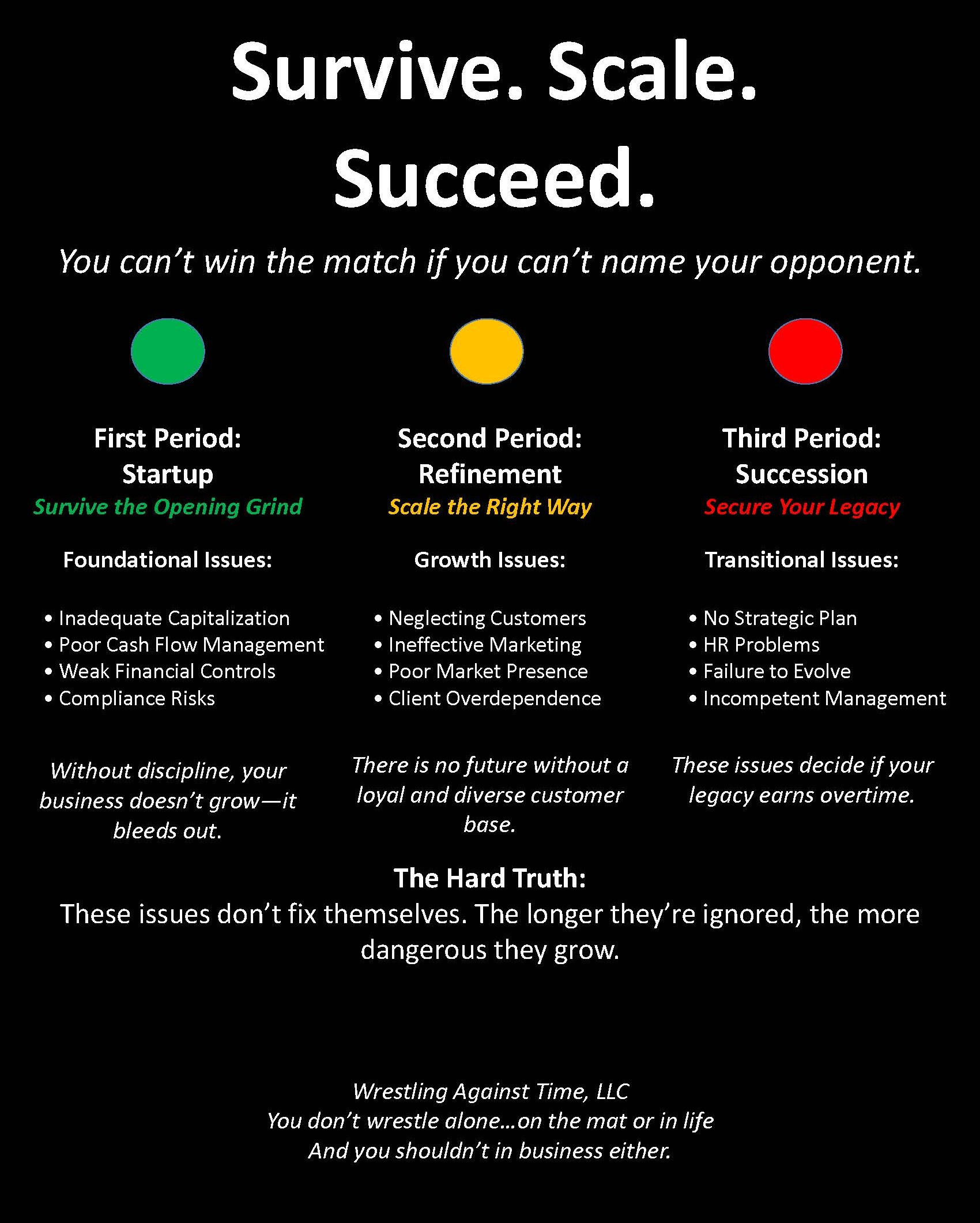
In Part 1, we focused on the financial and compliance issues that threaten a business in its earliest stage. In Part 2, we examined the operational issues that stall growth when owners stay busy but never build momentum. While each set of issues tends to show up most strongly in certain stages of the business lifecycle, all twelve are always present. They are the silent pressures that leak into daily operations and gradually weaken a business from the inside if leaders stop scanning for them. Part 3 shifts to the final stage, when the business is expected to operate beyond the founder and the question becomes whether the systems and people in place are strong enough to support that transition.
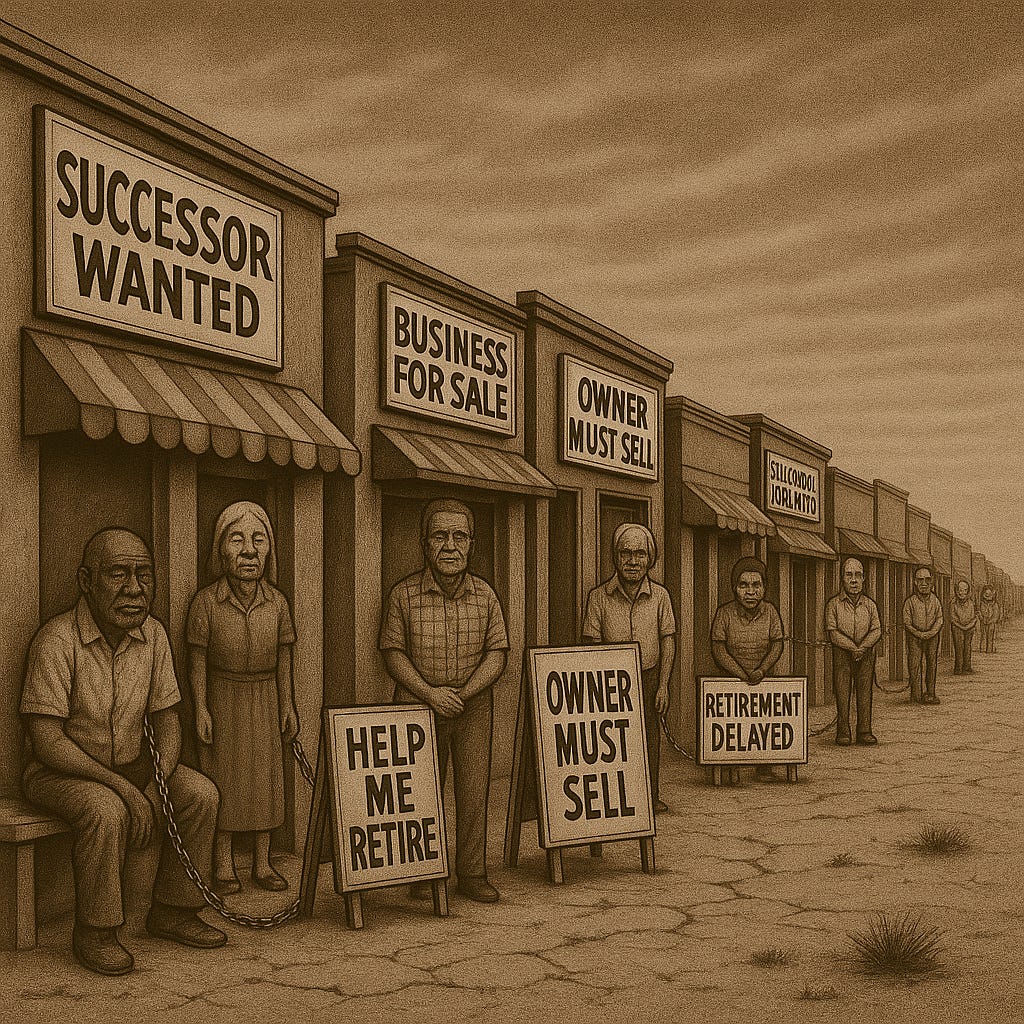
As a business reaches maturity, and the founder begins to imagine life beyond ownership, the challenge shifts from managing operations to ensuring those operations can continue once the founder steps away. At this stage, the founder must learn to focus less on day-to-day involvement and shift toward building the systems that enable others to lead. The last four fatal issues — lack of strategic planning, weak human resource systems, failure to evolve, and ineffective management — center on vision, structure, adaptability, and leadership. These final issues determine whether a company remains viable after the founder steps away, or whether it joins the over 60% of small family businesses that fail during the first generational transfer[i], or the 80% of small businesses that never find a buyer and simply close their doors[ii].
9. No Strategic Plan
In the start-up stage, and even while trying to scale, a lack of strategy is hidden in a sea of ringing phones, overflowing schedules, and constant hustle. That busyness can feel like forward progress when in reality every decision is reactionary. Instead of operating from a deliberate plan, the business responds to whatever feels most urgent in the moment rather than what is most strategic.
When the company is small, the founder can stay close to every job or client, which keeps the overall direction naturally aligned with the founder’s vision. But as the organization spreads across locations, product lines, or teams, that level of personal oversight is no longer possible. Growth creates opportunity, but it also adds complexity that demands more than intuition. At this stage, detailed planning becomes necessary to keep the company moving in the right direction. Without a written plan connecting operations, markets, financial realities, and leadership succession, the organization drifts and decisions become inconsistent.
This does not mean the company needs to adopt a heavy academic approach. Strategic planning can begin with defining the vision the firm is following, clarifying the direction it is heading, and establishing the frameworks that guide decision-making along the way. Well-documented processes filter distractions and keep attention on what matters most.
Companies that avoid this step keep working hard but rarely see their effort translate into real progress. During succession, that lack of alignment becomes costly because the next leader inherits motion without meaning and must try to build the map forward to a destination that lived only in the founder’s mind. And when the owner plans to sell rather than transfer the business, the problem shows up in a different way: prospective acquirers find a company that is entirely dependent on the founder for its strategy, with no structure that can replicate the founder’s vision once the founder is no longer in the business. With that level of concentration risk, each prospective buyer passes on the acquisition.
Why it matters:
90% of organizations fail to execute strategies effectively.[iii]
Strategic planning is a top differentiator for sustainable growth.[iv]
Lack of planning is a core reason many small businesses fail.[v]
10. HR Problems
Many small businesses grow from a core group of loyal individuals who feel a deep connection to the firm, having worked alongside the founder to get things launched. The shared experiences create a bond that makes work feel deeper than just a job. But as the company expands, those informal relationships begin to clash with the need for structure and accountability. New people join the team, sometimes in roles that carry significant authority, and the organization starts to shift. Expansion causes roles to blur, long-held responsibilities to move, and early employees to report to individuals who were not part of the original foundation. An environment and culture that once ran on trust and familiarity now requires performance standards, clearer expectations, and an evolving employee handbook.
Founders and owners often struggle with this transition because it is deeply personal. The organization begins to feel different, and without intending to, the dynamic shifts from a close-knit group to something that resembles a traditional owner–employee relationship. Correcting or replacing someone who “was there from the beginning” or who helped carry the load early on feels disloyal. Yet the greater responsibility is to the stability of the broader organization, not to any single individual. When these issues are ignored, the cost of avoidance compounds. The business becomes built around personalities instead of processes, and the culture turns reactive instead of intentional.
If the owner hopes to attract a buyer or a next-generation leader capable of taking the business forward, a healthy culture and strong HR procedures must already be in place. Without documented systems such as clear job descriptions, feedback cycles, and development plans, the company feels like a start-up frozen in its original culture, making it an unwelcoming landing spot for the next leader. Strong HR systems do more than support the current workforce; they signal that the company can operate independently of its founder and maintain the culture that made it successful. Without that, continuity becomes impossible.
Why it matters:
Firms with strong HR practices see 15–20% higher growth.[vi]
Only 32% of U.S. employees are engaged; disengagement costs $1.9 trillion annually.[vii]
Turnover costs 50–200% of an employee’s salary.[viii]
11. Failure to Evolve
We live in a world that is constantly evolving. Each day, new solutions to old problems emerge, and technologies leapfrog forward. Every industry changes, and every company eventually reaches a point where “that’s what we’ve always done” no longer fits. For many founders and owners, the habits that once built stability become the same habits that prevent adaptation. The company still operates, but each year the gap between its methods and the market’s expectations widens.
Failure to evolve is a fatal issue often amplified by the other assassins already named. If the firm lacks strategic planning, is poorly capitalized, or has a history of weak hiring, the likelihood of staying current is low. Upgrading technology, retraining staff, or redefining processes all require energy, and as the years roll on, owners often don’t feel the same energy they had during the start-up phase. If the business has not evolved, the owner likely finds themselves buried in daily operations or constantly playing firefighter, leaving little capacity to modernize.
By the time an owner prepares to exit, this stagnation shows up in valuation. Buyers discount companies built on outdated systems because modernization demands capital investment. For family firms, the next generation inherits an organization running on tools and ideas from another era, often with limited reserves to update or improve them. To survive beyond current ownership, the company must be solving today’s problems with current solutions, because owner energy alone cannot carry a business forward when operational overhead has become ingrained in the organization.
Why it matters:
52% of Fortune 500 firms since 2000 disappeared due to failure to adapt.[ix]
82% of small businesses fail, often tied to inability to adjust operations.[x]
Small businesses that adopt digital tools survive and grow at much higher rates.[xi]
12. Incompetent Management
Issue number twelve is one of the largest blind spots for small business owners and family leadership. Management incompetence isn’t about lack of intelligence; it’s about failing to recognize one’s own limitations. Many founders are experts in their trade or advanced in their profession to the point where starting their own firm became the next step. However, most never expected to go into business. They were never trained to balance budgets, lead people, or scale systems. Their technical skill drives early success, but as the company grows, leadership becomes less about doing and more about guiding.
When an owner doesn’t recognize the need for that shift, they become a bottleneck. Every question, decision, and approval funnels back to them because they believe their judgment is what made the business successful, and they never learn how to develop the skills in others to manage the process. The team learns dependency instead of initiative, and over time the organization cannot function without constant direction.
Occasionally, a potential spark for new leadership joins the organization. The owner may even give various individuals room to improve things for a while. But as soon as something doesn’t land exactly as the owner expected, the old habits of micromanagement return. The moment they feel out of control, they forget they are the owner and jump back into operator mode, which quickly turns into authoritarian mode. The once-promising crop of leaders, now receiving orders instead of guidance, eventually leave, and the cycle begins again.
This is the true barrier to succession. A buyer or successor cannot step into leadership if the team has never operated independently. Competent management isn’t about driving people harder; it’s about building systems that empower people to pursue the vision that has been laid out and equip them with the tools to make the decisions required for success. It’s about training them to guide the business beyond the current horizon. The best sign of leadership isn’t how well the business runs under the founder’s supervision, but how well it runs in their absence.
Why it matters:
Businesses overly dependent on the owner for decisions receive lower valuations, as buyers discount firms without a capable management bench.[xii]
Companies with effective, people-focused management are 4.2 times more likely to outperform peers, with 30% higher revenue growth and 5% lower attrition.[xiii]
A large percentage of frontline managers are “accidental managers,” promoted without leadership training, undermining team performance.[xiv]
Reflection: The Erosion of Continuity
These final issues represent the steepest part of the climb because by the time they are fully recognized, they are already ingrained in the everyday operation of the business. And by that point, most founders are too exhausted to lead the change process needed to prepare the company for the next leader. Founders built the business through endurance and personal sacrifice, and adding another layer of systems feels impossible.
Succession failure often occurs because, when it is time for founders to step back, the business has become inoperable by anyone else. Without documented plans, empowered managers, and adaptive systems, even profitable firms lose viability once due diligence reveals they cannot function without the founder present. Retirement dreams turn into years of extended work, waiting for the moment when we just need to do that one thing we never documented before the business can run on its own.
Legacy is preserved through structure, not memory. The next leader does not need the founder’s stamina; they need insight into the founder’s decision-making. They need a clear vision for survival and growth supported by systems that were tested when the founder’s instinct and experience were still there to guide them.
In the end, many small businesses fail because their founders didn’t build a business designed to survive, scale, and succeed. What most founders never realize is that the right time to plan your exit is the day you decide to start the business. Without that endpoint defined, you are not building toward a vision; you are simply driving the car without knowing where you are going. And no one is eager to take the wheel when they discover there is no map.
Closing Statement
Survival, scale, and succession are stages for a small business. They are periods along the same road the founder set out on the day the business launched, often without a map. At any point along that journey, any of the twelve issues outlined in this series can surface. They begin forming the moment a founder decides to step into business ownership.
The early, risky choices required to keep the business alive become workarounds, and those workarounds become ingrained in the business. What once helped the founder push through the firestorm of launching eventually traps them in an operating role they never wanted. The dream of owning a business turns into a nightmare where the business owns them.
The purpose of this series has been simple: to show where the cracks form, why they deepen, and how they limit a company’s ability to move through the stages of survival, scale, and succession. Small businesses do not fail because owners stop working hard. They fail because effort alone cannot overcome structural gaps that are never addressed.
Businesses that identify these issues early can build systems that support employee decision-making, attract customers, and create something successors will want to inherit or that acquirers will want to purchase. When owners rely on systems rather than instinct, their businesses gain the strength to stand on their own once the founder steps away.
This series is an invitation to build a company you truly own, rather than one that slowly becomes something that owns you.

The Cracks Beneath the Surface: Twelve Issues That Break Small Businesses From Within - Part 1 of 3

The Cracks Beneath the Surface: Twelve Issues That Break Small Businesses From Within (part 2 of 3)
[i] Williams, R. I., Jr., & Mullane, J. (2019). Family leadership succession and firm performance
[ii] Exit Planning Institute (EPI). “State of Owner Readiness” report.
[iii] IntelliBridge. (2021). Strategy execution statistics.
[iv] Forbes. (2013, 2023, 2024). Small business and diversification studies.
[v] ProfileTree. (2024). Why strategic planning matters.
[vi] Messersmith, J., & Guthrie, J. (2010). High performance work systems in small firms.
[vii] Gallup. (2023). State of the American workplace.
[viii] Center for American Progress. (2019). The cost of employee turnover.
[ix] DXC Technology. (2017). Adapt or perish: Business transformation insights.
[x] Investopedia. (2024). Small business survival rates.
[xi] U.S. Chamber of Commerce. (n.d.). Small business digital adoption report.
[xii] International Business Brokers Association (IBBA) & M&A Source. (2023). Market Pulse Report.
[xiii] McKinsey & Company. (2024). The State of Organizations report.
[xiv] Belbin Associates. (n.d.). Accidental managers research.