
The Trapped Operator - Preview
How to Build a Small Business That Runs Without You - by Peter S. Bergeron

INTRODUCTION: The Story Behind the Framework
This was never a destination. A framework, let alone a book about a framework, was not anything I envisioned I would create. Ending up in places I didn’t envision is not unusual for me. Ending up with my focus tied directly to small business and tangentially attached to wrestling is less surprising. Both were shaping my future before I understood how.
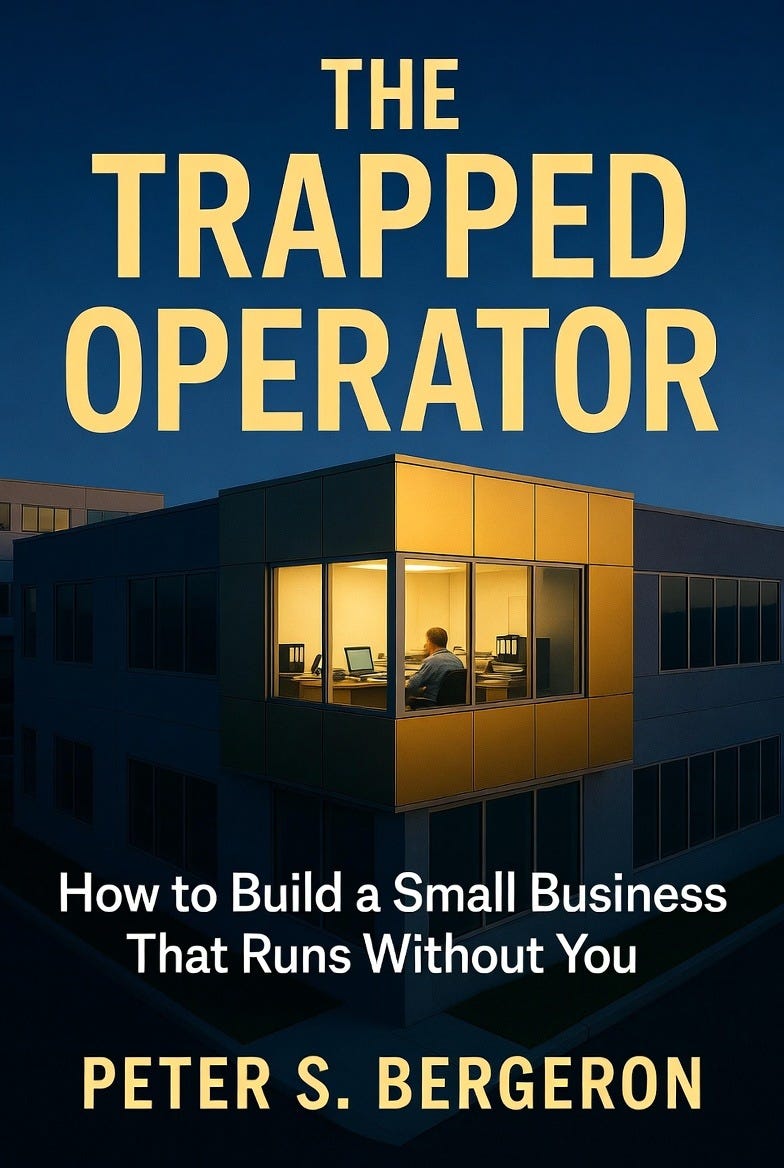
Ok, I can already feel the question forming. If this wasn’t a destination, what exactly is it? And why does it start with a framework? This book was supposed to be about freeing you from being owned by your business, not explaining how someone built a model.
Fair. But, before we get to the framework, let me give you the story behind it. A few pages. That is all I need to explain how someone who grew up inside his dad’s small business, never quite seemed to fit inside it, went down a different path, found his way back, and was forced to be the one to close its doors for the last time on January 13, 2020. How, for years after I was forced to close the doors, I spent more hours than I can count trying to understand why it all unfolded like it did.
The answers, when they finally came, were not what I expected. They were not about what we had done wrong, although there were plenty of things done wrong. They were about not having the right lens to see what was actually happening inside the business. The models small business owners are given do not fit the reality small business owners live in.
The systems we are told to follow, the frameworks handed down from the academic world, are truncated versions of large corporate models that miss the most essential element of small business entirely: the owner’s personal connection to what they built. And if the map is wrong, it is near impossible to reach your destination.
What I also found was that we were not alone. What we had experienced was far more common than I had ever known. And when I went looking for a model, a framework, or a diagnostic instrument that used the lens through which I had lived it, I could not find one. So I started developing one, drawing on what I was studying in the doctoral program but building from the ground up rather than scaling down from the top. The goal was a model that fit the actual size and complexity of a small business at every stage of its development, not a hand-me-down from a larger framework that never quite fit right no matter how many times you tried to make it work.
What I built was not assembled from my own beliefs or a single experience. It was formulated through decades of living inside small businesses across different industries, ownership structures, and leadership styles. It was shaped by hundreds of conversations with owners navigating the same pressures in completely different contexts, and by the patterns that kept emerging regardless of the surface differences between their businesses.
It was tested against academic research, interrogated against existing theory, and refined by looking for the gaps that the existing literature could not explain. What resulted is not a motivational framework or a corporate methodology dressed down for a smaller audience. It is a diagnostic instrument built specifically for the business of running a small business, in the language of someone who has lived it from the inside.
That is why I wrote this book, not born out of regret, but out of the belief that if one person can see their business more clearly because of what I lived and learned, then the losses along the way become something other than losses. They become the cost of a lesson worth passing forward. The Trapped Operator is a lifeline for the owner drowning in a business that never lets go of them. Not a motivational push. Not a corporate playbook repackaged for a smaller audience. A real diagnosis, built from the inside of small business, that validates what you have already been feeling and gives you a language to finally name it, and points you toward a path to free yourself of being owned by your business.
My introduction to small business started before I understood what owning a business meant, when my dad founded Land & Sea, Inc. in the spring of 1977, when I was four years old. That business was another presence in our household growing up. It was not a distant asset, it was a living member of our family that competed for attention at the dinner table, demanded weekends, and shaped the way our family moved through the world. For an only child, it was the closest thing I had to a sibling. If you grew up in or around a small business, you know exactly what I mean.
By six, I was spending time at the shop with my dad matching packing lists against purchase orders to approve incoming shipments while he was working on an engine modification. It wasn’t a summer chore. It was one of the many ways I learned how small business, and life, worked.
Other lessons came by way of the dinner table and car rides, where the education ran in two directions. My dad was an engineer at his core, always turning over the next modification that would make a boat go faster, perform better, push a little harder against its limits. My mother’s side of it was accounting. She went back to school at night in the fall of 1979, eventually earning both her bachelor’s and her master’s degrees in accounting while working and raising a family.
Two years later, in November 1980, a coach named Mr. Lane introduced me to the sport of wrestling. I was eight years old. One afternoon at the Salem Boys Club, two older kids had been teasing me non-stop, and I was sitting outside the director’s office, all 48 pounds of me, unable to stop crying.
A large hand came out of nowhere, wrapped around my face, and tilted it up. Mr. Lane, a mountain of a man who I had never met, knelt down and asked me why I was crying. I was too upset to get a word out, and he would love sharing that part of the story every chance he got, always using his hands to reenact the tears streaming down my face. What came next, delivered quietly and without ceremony, was:
“You need to stop crying...because one day you might want to be one of my boys, and my boys don’t cry.”
It wasn’t dismissive or insulting. It was a lifeline. It was the first time anyone outside my family took the time to look at me and help me see something I couldn’t yet see in myself.
What happened on that mat over the next several years did not just teach me a sport. It taught me a method. Mr. Lane taught me to read what was in front of me before I moved, to break down what an opponent was trying to do and position myself so they moved the way I needed them to. He taught me that setbacks are not failures, they are information, and that the only unacceptable response to a hard moment is to stop learning from it.
He also taught me something that took longer to understand: that the strongest person in the room has a responsibility to the weakest one in it. When I was wrestling a kid just learning the sport, Mr. Lane would have me let them work, let them feel what it was like to score on someone, before he’d whisper from the corner “ok, now” — my signal that the lesson was over and I could wrestle normally. Then shake their hand, tell them what they did well, and mean it. That is how he had treated me. That is how he expected his boys to treat others.
The kitchen table and the wrestling mat were different classrooms, shaping my future. One taught me the content: engineering, accounting, systems, patterns, how things work. The other taught me the method: observation, quick diagnosis, seeing what someone else cannot see about their own situation, and finding a path through it. I would not have a name for that combination for another forty years. But it was already forming.
None of that made me destined to work inside the family business. Actually, the opposite seemed likely, given that Land & Sea is the only job I have ever been fired from. I was fourteen. Dad had mom deliver the news.
“Dad thinks it might be best if you found work somewhere else this summer,” she said. It wasn’t said badly. She herself had long since moved on to working outside his business.
So I got on my bike and pedaled down to Dockside Marina, where a husband and wife had built B&H Oil into a family fuel delivery operation and later added the gas station on Arlington Pond in Salem, New Hampshire. I felt something familiar there: the way things moved through the company, how the people inside treated each other, the bond they had built with the community they served. These types of businesses would continue to draw me in for the rest of my career. There is a good chance you have been inside one just like it, either as a customer, an employee, or a kid sitting in the back office waiting for a parent to finish up.
After graduating from Salem High I attended the University of New Hampshire. I only went to college because that’s what all my friends were doing. I wasn’t sure what I wanted to do, but I had a pretty good idea of what I didn’t. Honors Physics and Honors Calculus had kicked my ass enough in high school for me to know that engineering was not in my future. I ended up majoring in Economics by default.
An internship surfaced through a fraternity connection my senior year at a small family financial services firm. It became a job offer when I graduated in May 1995. I discovered I was not built for sales, but the role let me coach high school wrestling, which I loved. When the bookkeeper retired, those responsibilities landed on me too. That was when I realized that how money moved through an organization made sense to me in a way that sales never had. The lens my dinner table years had built turned out to be exactly what operations and finance required.
In June 1997, I had bought my grandparents’ house on Governors Lake when my grandmother passed. The big rock a few feet in the water in front of the house is where my mother and father had met as teenagers when both families were spending their summers at the cottages on the little lake in Raymond, NH.
On 4th of July 1998, I met my future wife, as Caroline and her twin sister had been invited to my 4th of July party by one of my fraternity brothers. By Columbus Day 1998 Caroline and I were engaged and we got married on July 23, 1999.
I moved through a controller role at a job shop, realized my economics degree wasn’t going to be enough, and went back to school at night for my MBA starting in September 1999, at the same school my mother had attended. A controller position at a beer distributor followed. While I was at the beer distributor, our son was born in October 2000 on my birthday.
By the summer of 2001, as the finish line for my MBA came into view, my dad called with what passed for a job offer:
“I think you might finally be smart enough to come work for me.”
That line tells you everything about our relationship. The only company I had ever been fired from was his. My current position came with the benefit of a beer or two at my desk after 4pm. Despite all of that, when I received his offer, I said yes without hesitation.
I started at Land & Sea on August 20, 2001. Less than a month later, September 11 happened, and it was the first time I felt the fear of financial free fall inside a small business. The phones stopped. No emails came in. Revenue dried up as the world tried to understand what had just happened. By the end of 2001, as tradeshow season wrapped up, things were starting to stabilize. A little over my year into working for my dad, Caroline and I welcomed our daughter in November 2002.

For nearly two decades, I ran the business around him. He was the engineering mind, the market driver, the institutional core of everything the company had built. I controlled the financial infrastructure, the administrative structure, and the operational systems. What I did not understand then, what I could not see, was that running the business around him and building a business that could run without him were two entirely different things.
We started down the generational transfer path in 2017. For a myriad of reasons, some of them addressed by the framework and others a story for another book, it quickly trended toward failure, so we shifted our focus to finding an acquirer. I could fill the next twenty pages with everything that went wrong in those years. But I would come to realize that what went wrong in 2017 started forming long before 2017.
My dad passed unexpectedly in May 2019, before we were able to find a buyer. The phone call came on my way home from work, and Caroline and I rushed to my parents’ house. We stayed for hours with my mom, my aunts, and my uncles. All of it still feels like an out-of-body experience.
The next morning, I was at work because someone had to be. Someone needed to assume my dad’s role, or attempt to, because that is what a small business demands from its trapped operator. I needed to tell the employees. I needed to get payroll processed. Most of that Caroline handled, taking time off immediately to carry what I could not. She was our rock through it all.
The days, weeks, and months that surrounded the closure created a kind of pressure that compresses time in ways that are hard to understand if you haven’t walked through it. Emergency conversations with lenders, customers with open deposits wanting answers we did not have, employees showing up every day to a business running on borrowed everything.
In the end, I was the one who had to decide to close the doors. I did that on January 13, 2020. By March 31, two weeks into a global pandemic, with court liens to clear and creditors who were not going to wait another day, we completed a transaction to sell the product line to a competitor. It was not the ending we had been building toward through all those years, but we avoided a worse one.
I watched a business built over decades, one that represented not just income but identity, legacy, and the accumulated effort of a generation, fail to survive on its own. The business had been viable. The people involved cared deeply. What was missing was the structure required to carry it forward, because that knowledge lived in one person. The decisions had always flowed through a single point of contact. When that point of contact was no longer there, the business could not hold.
After the deal closed in April 2020, I went back to what I knew, humbled by the past 20 years. My first step outside the family business in twenty years was familiar ground: a senior role in Wisconsin at the family business that had acquired the product line from Land & Sea. From there I moved into a controller position at a large manufacturing plant, and by July 2022 I was Vice President of Finance and Administration at a multi-state real estate firm, eventually moving to CFO/COO.
On the surface, life seemed pretty good. But underneath, my mind kept returning to the same questions. What had we done wrong? Why had the succession not worked? Why was the sale not simply a matter of showing them around and handing over the keys? Why did everything fall apart?
With those questions taking up so much space in my mind, in August 2023, at 50 years old, I went back to school at night to pursue a doctorate in business administration with a focus on organizational development. The credential was not the point. I needed to understand what I had done wrong and why we could not successfully continue the business without my dad. I needed to know why I had failed to carry on his legacy.
My first research assignment made something clear that I had not expected to find: the cavalry was not coming to save small business owners from suffering the same fate I had faced. In 1986, Dr. Richard Dyer made his first pronouncements that research was needed on the high failure rate of family business generational transfers.
Forty years later, the numbers have not improved. Roughly 70 percent[i] of family businesses do not survive their first generational transfer, and over 80 percent[ii] of small business owners who plan to sell as part of their retirement never successfully do.
I quickly realized that what had happened to us was not a family problem or a personal failure. Academia had identified this as a persistent challenge facing the majority of small businesses when it comes time for the founder to attempt the same transition. But it was one that was not yet truly understood.
The research literature pointed to process as the answer: better planning, better legal structure, better communication between generations. It was a reasonable conclusion.
It was also forty years old, and the numbers had not moved. That did not sit with me. If the process answer were right, the results would have improved. They hadn’t. So I kept thinking and digging, and eventually I found myself back at one of my dad’s throwaway lines, delivered the way he delivered most things: plainly, without ceremony, as though it were obvious.
“There are only so many problems a small business faces. Eliminate them and you are fine.”
The deeper I went into the literature on small business failure, succession, and organizational dynamics, the more that line felt less like a throwaway and more like a hypothesis. There are not an unlimited number of problems. They are finite. Identifiable. They appear in patterns. And the patterns are not random.
Eventually, I began referring to these recurring issues as the 12 Fatal Issues for Small Business. A few months later, in early 2025, I launched Wrestling Against Time, a consulting practice built to help owners see and address them.
These issues did not simply create problems to solve. Over time, they quietly reshaped what ownership actually looked like for the people inside those businesses. Owners who had started with a vision of building something found themselves consumed by the daily demands of running it. The decisions they made were not the problem. The structure underneath them had never been built to carry the weight they were asking it to hold.
Operating a business means being forced into the trenches every day because the business demands it. You didn’t choose it. The business chose for you. Owning a business means building something capable of sustaining itself without your constant involvement. Most small business owners set out with the intention of owning but end up as operators, trapped in a job they created for themselves. The distance between those two outcomes is not a function of effort. It is a function of structure.
Naming the issues helped immediately. Business owners recognized familiar patterns inside their own companies within minutes of the first conversation. Most could quickly point to several of these issues already at work. The names created a shared vocabulary for something that had previously felt vague and personal: the sense that something was wrong but could not be precisely identified. Naming gave owners permission to stop treating every problem as a personal failure and start treating them as conditions that could be understood and addressed.
But as I continued working with businesses through this lens, something else became clear. Naming the issues explained the symptoms, identified the damage they caused, and helped diagnose the path to addressing them. What naming them did not do was explain why the same issues kept reappearing inside companies that had already overcome them, and why it happened to companies of different sizes, in different industries, at different stages of their lives. The names gave clarity to describe what was happening. They did not explain the system that was producing it.
The twelve issues represent the visible cracks that appear inside the organization. The Fatal Issues Framework™ represents the structural model that explains why those cracks repeatedly form in the same places.
That shift, from naming issues to diagnosing structure, is what transformed the 12 Fatal Issues for Small Business from a list into a complete framework. The framework is not designed to be a survival checklist. It is not a motivational inventory. The 12 Fatal Issues are not a list of small business problems, because framing them as just a list misses the point entirely.
These twelve issues are pressure points inside the structural systems of the small business. They break through where the structure is weak. They spread when the systems designed to withstand them crack under pressure. Understanding that relationship changes what you look for, what you prioritize, and how you build something capable of outlasting you.
The goal of what follows is structural strength. Not perfection. Not the elimination of every weakness. Structural strength: the capacity to contain pressure before it spreads, and to build systems that can absorb the next disruption without compromising the whole.
How This Book Is Organized
I wrote this book with a deliberate cadence. It is designed to build your understanding of how the framework looks at small business differently, why I believe those differences are valid, and then to step you inside the framework so you can experience it firsthand.
Part One builds the structural foundation. You will learn what the three operational states are and how your business moves between them, how the twelve issues cluster into three issue groups based on when they become most acute, how the four structural systems distribute pressure across the organization, and why containment rather than elimination determines whether pressure stays manageable or spreads. By the end of Part One, you will have the terminology and structural understanding that makes everything that follows more than a list.
Part Two is where you step inside the framework for the first time. A six-question structural assessment, The Fatal Snapshot™, surfaces which of your three issue groups are under the most structural strain right now. Your results place you inside one of eight business profiles, each describing a recognizable structural condition with its own characteristic pressures, its own risk pattern, and its own priorities. This is the moment the framework stops being abstract and starts being specific to your business.
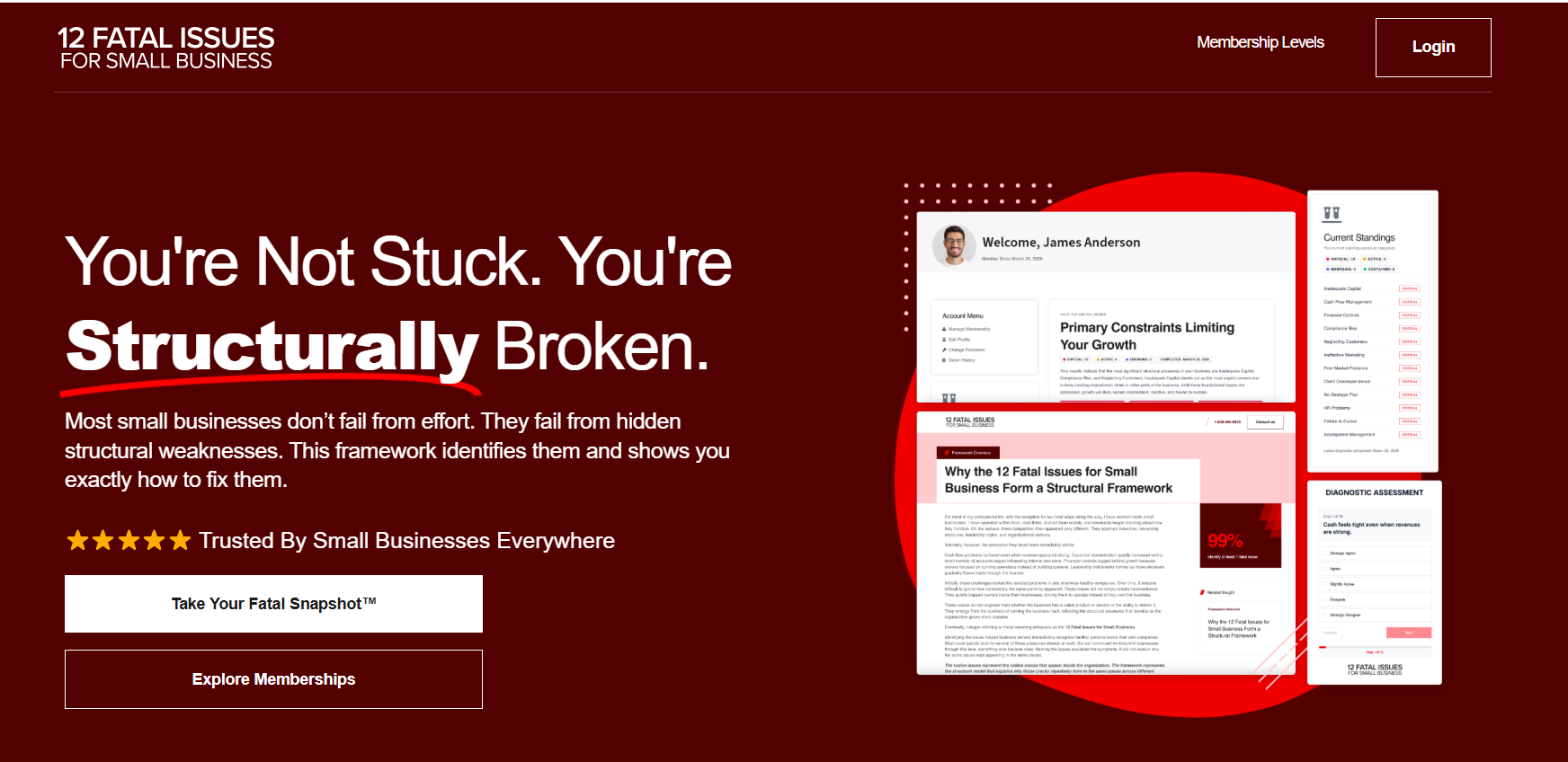
Within Part Two you will also find invitations to extend your experience at 12fatalissues.com, where the extended diagnostic goes significantly deeper than six questions. That deeper assessment produces a structural map of your business, showing precisely where pressure is concentrating across all four systems and all twelve issues. Your book purchase includes 90-day complimentary premium access to the full diagnostic and everything that comes with it.
Part Three prepares you to read Part Four correctly. It explains why the profiles are intentionally broad, how individual issue-level pressure works differently from group-level pressure, and what structural strength actually produces over time. This is the section that transforms Part Four from a reference list into a diagnostic tool.
Part Four examines each of the twelve fatal issues in depth. For every issue you will find the research that validates why it matters and three specific containment disciplines that address the underlying condition rather than the symptom. The issues are presented in the order the framework’s design recommends, not by severity, because severity depends on which state your business is currently navigating. If you have not yet completed the deeper diagnostic, doing so before you begin Part Four will tell you which of the twelve issues deserve your immediate attention and which can wait.
Part Five is a brief closing that points forward rather than back.
The path to structural strength begins with understanding why the cracks form. Not just where. Why.

You can read the rest of the latest Prerelease Draft version and gain 90-days of premium access to the 12fatalissues.com website, for just $14.99 (over a $200 value!).
You can grab your copy or preview it here:
https://12fatalissues.com/membership-checkout/?pmpro_level=9
[i] Cornell SC Johnson College of Business. (2026). Family business facts. https://business.cornell.edu/centers/smith/resources/family-business-facts/
[ii] Exit Planning Institute. (2023). State of Owner Readiness. https://exit-planning-institute.org/state-of-owner-readiness/
I really like the updated cover and subtitle - well done! It works better and a less gloomy graphic than before encourages more people to read/buy. 🙏🏼