

This is a lightly revised version of an article I originally wrote in May 2024—one of the first pieces I shared publicly on LinkedIn. I’ve updated it slightly for clarity, but the core thinking remains the same. Sometimes looking back helps sharpen the lens.
Mechanicalistic organizations, with their deep rooted bureaucratic operating structure, lack the flexibility and agility to deal with unstable environments. In the 1950’s, the general system theory provided the concept that organizations do not exist in a vacuum, but rather they are part of a larger, overreaching universe which theorists called the organizational environment. This is the start of the evolution of the metaphor of business as a machine to one of business being a living organism that is a contributing member of, and influenced by, a larger environment. Business leaders need to understand the constraints, or rules, put on the organization by its environment.
Within nature, as with business, the concept of emergence theory points to individual actors, or parts, making up a larger environment and that everyone within that environment behaves in a certain way as if following specific rules. Examples of emergence within nature can be seen as ants move supplies in and out of their colony or birds flight patterns during migrations.
Emergence theory states that there is no leader, no indication given from one fish to the other that the school is heading in a specific direction. The crowd just continues to follow the rules, until one of the actors decides to shift.
Why did the individual shift, at that moment, what warning sign ahead told that actor now was the time the rules needed to be broken or interpreted differently? What is it that makes these individuals figure out a way to stand out in a crowd?
In a discussion board prompt early in our DBA program included a video regarding a computer simulation for checkers and discussed how the program “learned” which move was correct. Why was this capable? Did the program develop its own code to track all the moves made, then what each proceeding move is, and then calculate the best statistical option each time it is the computer’s turn to move or rather was all this logic programmed into the "brains” of the system? The genius is not in what the computer did, rather that the programmer could produce the math to lead to that “system”.
Programming the best “system” is what business leaders are charged to do when developing strategies for dealing with upset conditions within their organizations.
It is the development of a system, with the insight to have rules that are held tight while providing opportunities to evolve as new information becomes available within the operating system which is vital for organizational survival.
The ability to utilize experiences from previous events to develop a quick plan to face new challenges is what great leaders do. The ability to see further ahead, to have an indicator earlier than others that the path being followed is leading everyone off a cliff, is what separates great leaders from the crowd.
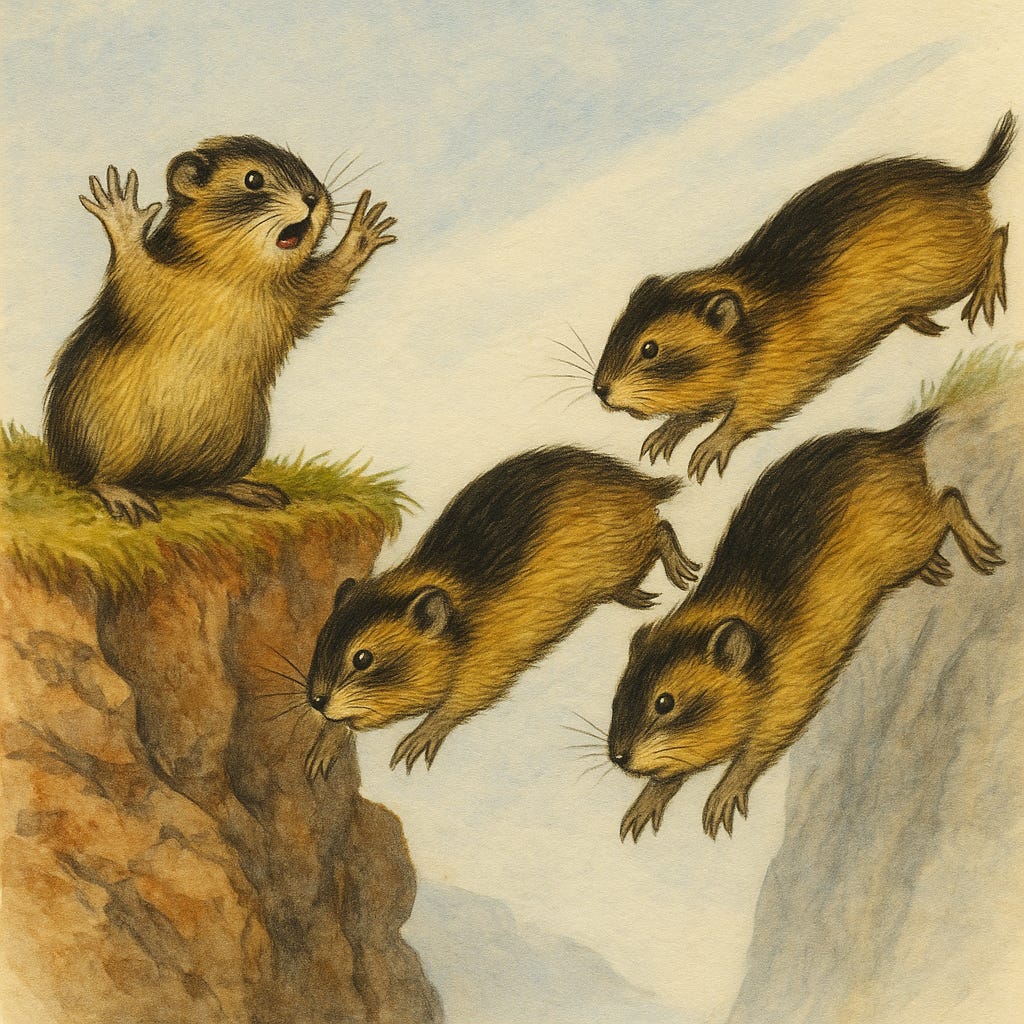
If business leaders fail to develop these analytical skills, the organization will end up like a bunch of lemmings following a migration path off a cliff.
References:
Doan, M. (2019, September 19). Emergence: a Concept to Help Your Business Thrive.
Hatch, M.J. (2018). Organization Theory: Modern, symbolic, and postmodern perspectives. Oxford University Press
Morgan, G. (2006). Images of Organization. Sage Publications, Inc.