

We’ve all heard “Cash is King,” but in small business, “Timing of Cash is God.” Cash flow isn’t just money in and money out. It’s the heartbeat of your business. You can be profitable on paper and still be forced to close if the timing of cash flows does not properly align. A 2024 report showed 82% of small business failures are due to poor cash flow management.[i]
Not bad ideas. Not lazy teams. Not poor marketing. Cash flow management. It is the second fatal issue for a reason. Even if you dodge the inadequate capital trap during launch, poor cash flow management can defeat your business faster than you can say “overdue invoice.”
I have seen owners, good ones, crumble under the weight of cash flow mismanagement. One missed payroll becomes two. Vendors stop delivering. You are begging for ten more days while trying to hide your panic from the team.
We all know the owner who dipped into their kid’s college fund to cover a supplier bill, swearing it was a one-time thing, only to repeat it until there was no college fund left. That is what poor cash flow does. It does not just break businesses. It breaks your spirit.
My first lesson on cash flow management came while working for a small machine shop early in my career. A “top tier” client took eighteen months to “accept” our product. It sat in their quality control department with no rework requested, no return of non-conforming parts, and each time I called about the receivable, I was told the parts were still awaiting acceptance.
When the parts were finally “accepted,” the client still took the 5% discount for paying within ten days of acceptance. I brought it to the president of our company, only to be told that this customer was too important to lose. We would have to accept their terms, no matter how absurd.
Meanwhile, our shop was bleeding cash and struggling to cover basic operating expenses. When we needed to lease two new pieces of equipment, the agent asked why we never had any cash on hand. Spoiler alert: it was all trapped in receivables.
At its core, poor cash flow management is the inability to maintain a steady inflow of cash to meet immediate expenses. But it is more than that. It also includes the discipline to manage money physically and mentally. You must keep tax liabilities separate from working capital, resist the urge to move money prematurely, and understand the rhythm of your operation.
Strong cash flow management means knowing when the cash will arrive and how to control it. It means deciding which vendors get paid today and which ones might let you slide. It is knowing who is a stickler that will call over a one-day delay, and who still calls you a great client even when you are 75 days late on a hefty invoice.
Cash flow tracks the movement of money into and out of your business, making sure there is enough on hand to cover payroll, rent, vendors, and the inevitable curveballs. With the right systems in place, you can finally retire the exhausting art of vendor juggling.
Seriously, it’s a big problem!
While inadequate capitalization may be the gatekeeper of the 12 Fatal Issues, poor cash flow management stands at the top of the podium as the reigning champion of the dirty dozen. It contributes to an estimated 82 percent of small business failures.[ii]
It is a silent killer. It does not always show up with flashing lights or sudden collapse. More often, it hides in plain sight. The business looks busy. Sales are happening. Customers are happy. But the money is not showing up in time to cover expenses. That mismatch between revenue and liquidity creates a slow, steady bleed. Receivables get delayed, payment cycles stretch, and the owner ends up juggling bills, missing paychecks, and praying payroll clears. In 2024, 60% of small businesses reported active cash flow issues, with 64% experiencing payment delays averaging 43 days.[iii]
This is not an isolated problem. It is a systemic failure. One in five small businesses report being unable to pay bills on time because the cash is simply not there when needed. Forty-five percent of owners admit to withholding their own pay just to keep things afloat.[iv]
Another review found that while 60% of businesses face cash flow trouble, a staggering 89% say it directly affects their ability to operate.[v] That includes halted inventory orders, missed growth opportunities, and broken trust with vendors. Paper profits do not pay bills. A company can look great on paper and still fall apart in practice if the cash is not timed correctly. Cash flow is not just money. It is time. And when you run out of either, the game is over.
The trap is especially cruel because it feels like a problem you can outrun. You tell yourself, “We have money coming.” But the bills do not care. Payroll is due Friday. The landlord wants the check. That big client who promised payment by the 15th? Nothing but silence. You start juggling—robbing Peter to pay Paul, delaying vendor payments, maxing out credit cards. It creates financial whiplash and slowly erodes trust from every direction: the bank, your vendors, your team, and worst of all, yourself.
Cash flow mismanagement hits across all three periods of a business:
· First Period (Startup): A single late payment can sink you. One client delay means no payroll, no supplies, and no survival.
· Second Period (Refinement): Growth devours cash faster than it creates it. Scaling without timing control turns potential into debt.
· Third Period (Succession): Poor cash flow ruins your exit plan. No one wants to buy a business that is always one invoice away from collapse.
The Ripple Effect
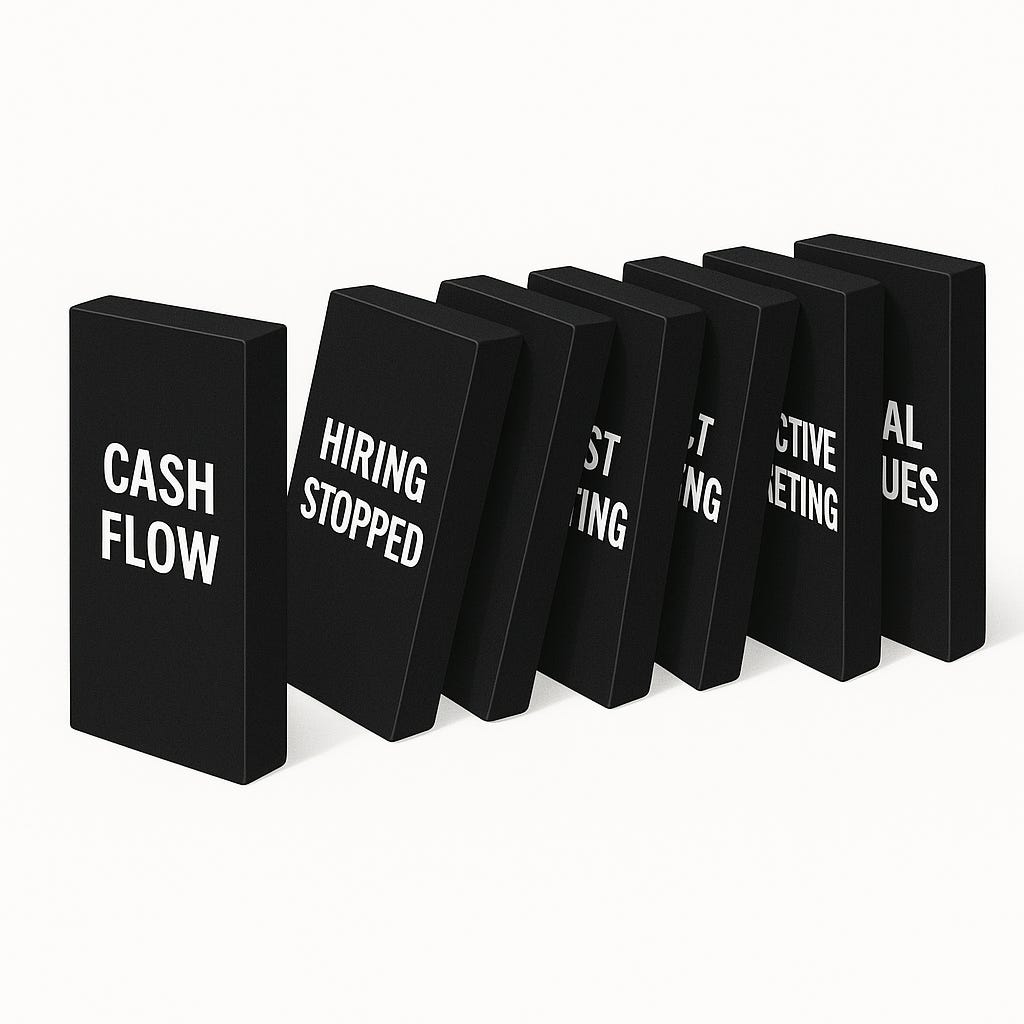
Cash flow is not just a finance issue. It is the first domino in a chain reaction that can topple everything else. One delayed payment can stop you from hiring the right talent or building a leadership team. As we will see in Chapter 4, that becomes a major driver of management incompetence. Poor cash flow also forces reactive cost cutting—the kind of short-term decisions that do long-term damage. In Chapter 7, we will explore how ineffective marketing becomes another casualty when cash gets tight and visibility fades. Cash flow is the thread that connects all twelve of the Fatal Issues. When that thread snaps, the whole structure begins to fall.
Understanding Poor Cash Flow Management
Cash flow problems stem from a mix of inexperience, optimism, and systemic failures. Here’s why they happen:
· The Float Trap (Invoicing ≠ Income): Owners often mistake invoices for actual cash. You might bill $100,000, but only $40,000 makes it to the bank. Expenses do not wait for receivables. Growth only amplifies the issue—new hires, a larger office, and increased inventory all consume cash before revenue has a chance to catch up. A 2024 survey found that 54 percent of owners lack confidence in financial management, often because they do not fully understand this gap.[vi]
· Neglecting Cash Logistics: Many small business owners focus on driving sales rather than building a system to manage incoming cash. You land a big deal but fail to enforce payment terms or actively monitor receivables. My dad used to say, “A sale is just a promise until the check clears.” Think back to the earlier example of the client who held all the leverage. Our leadership was busy celebrating the size of the invoices, while our bank account required cash calls from ownership. Vendors were left confused about why we were not paying on time.
· Growth Paradox: Expansion often outpaces available cash. A 2025 survey found that 41 percent of small businesses experienced revenue declines, making aggressive growth bets even riskier.[vii] Scaling without a cash buffer can turn potential into debt.
· Market Cycle Ignorance: Many new owners have never experienced a full economic downturn. Economic cycles typically average 5.5 years, with recessions lasting around 11 months when they occur.[viii] Small businesses, with limited pricing power and smaller reserves, tend to feel these swings more acutely. A 2025 survey showed that 35 percent of small businesses were operating at a loss, highlighting just how volatile the environment can be.[ix] Now, I am not going to pretend that some business owners do not engage in creative tax accounting to report a loss. We all know those cases exist. But given how frequently business closures are tied to cash flow issues, the broader trend is still relevant and worth your attention.
· Over-Reliance on Expected Revenue: Assuming clients will pay on time is a rookie mistake. A recent report shows that 64 percent of small businesses experience payment delays averaging 43 days.[x] That is 43 days of holding your breath, hoping the check clears before your credit card balance does.
· The Optimism Bias: Entrepreneurs are naturally wired for hope. “The next check will save us,” I told myself during one particularly tight stretch. My dad slapped a ledger on the desk and said, “Hope doesn’t pay the electric bill.” Optimism fuels startups, but it often blinds owners to the realities of cash flow. A 2024 study found that 60 percent of small business owners lack accounting confidence, relying more on gut instinct than hard numbers.[xi]
Impact of Poor Cash Flow Management
· Operational Struggles: Missed payrolls, delayed shipments, and unpaid vendors disrupt daily operations and damage trust. A 2024 survey found that 22 percent of small businesses struggle to pay bills on time due to cash flow issues.[xii]
· Credit Challenges: Late payments weaken your credit profile, making it harder to access financing when you need it most. In 2022, only 36 percent of small businesses that applied for financing were approved.[xiii]
· Insolvency Risk: Ongoing cash shortages eventually lead to insolvency. The SBA continues to cite cash flow issues as the number one cause of small business failure.[xiv]
Case Study – The VIP Lifestyle… on a Happy Hour Budget
Trevor and Dave, two friends, launched a cocktail catering business with equal funding—$50,000 each. But only one of them succeeded. Their story shows how cash flow management separates the tortoises from the hares.
Trevor wanted to make a splash. He styled himself as the VIP of the catering scene, investing heavily in appearance. He spent $10,000 on luxury branding—a sleek logo, a polished website, and custom glassware. He leased a van for $1,200 a month, hired a full-time staff with a $15,000 monthly payroll, and threw a $5,000 launch party to impress influencers. His pitch: premium events at premium prices. But he also offered generous terms—net 60 with no deposits—because, as he said, “big clients expect flexibility.”
That flexibility backfired. A $20,000 invoice went unpaid for 90 days. Vendors started demanding payment upfront. Payroll checks bounced. By month six, Trevor was $30,000 in debt. His van was repossessed. His team was gone. The business folded. Trevor went back to bartending to pay off loans.
